Login
 Chart





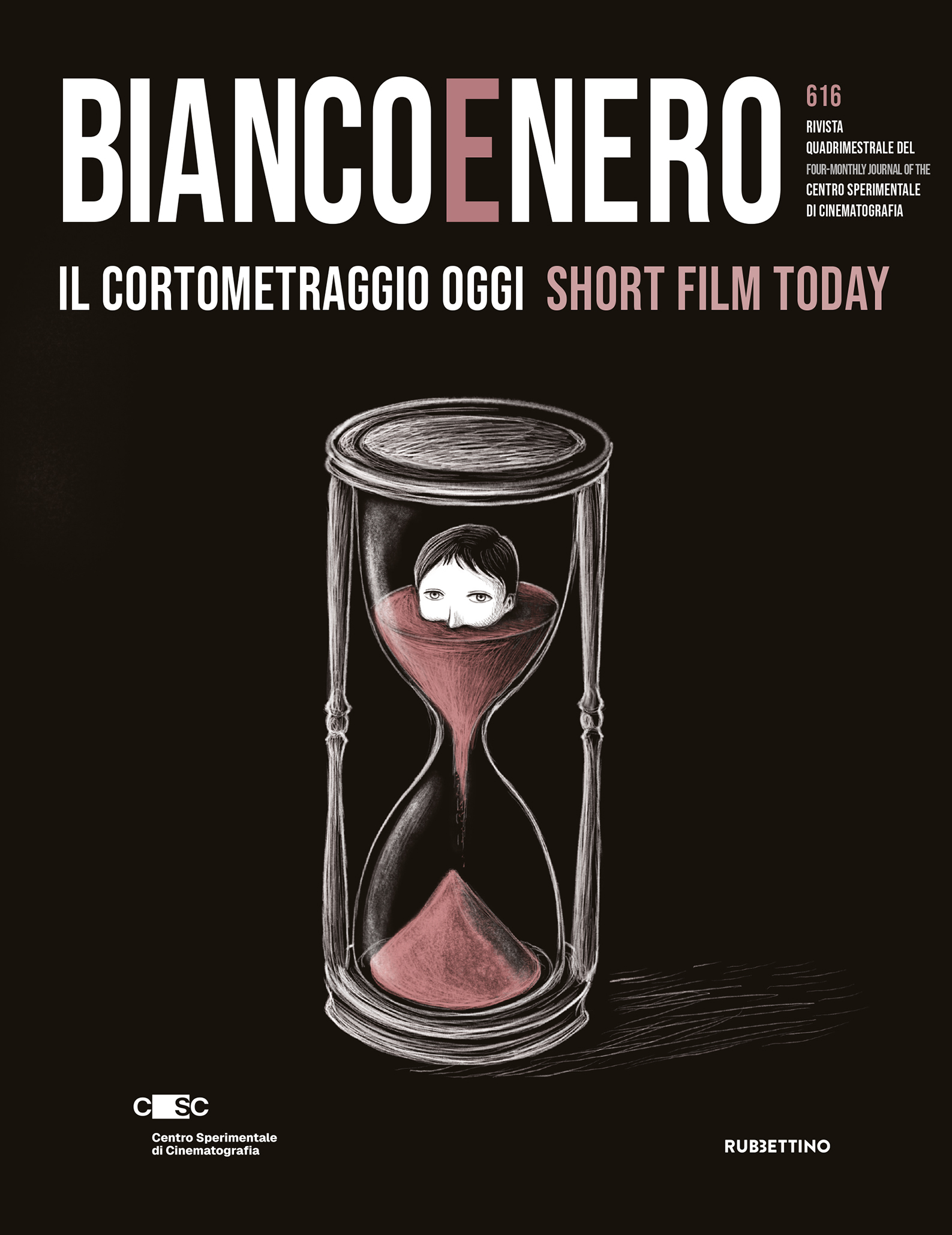
Author: Simone Bardoni and Giulio Sangiorgio (eds.)
Year: 2026
Pages: 215
Publisher: Centro Sperimentale di Cinematografia; Rubbettino
ISBN: 9788849891270
Description
This issue of Bianco e Nero is a special one because it opens onto an international dimension while trying to answer the question, “What is the short film today?” And it is special because it is conceived in connection with the first CSC International Student Film Festival (ISFF), directed by Marco Bellocchio. From 11 to 15 November, this event brings together short films from film schools around the world to the historic headquarters of the Centro Sperimentale di Cinematografia in Rome: nearly 1,700 films submitted from 101 countries. This is why the issue is written in two languages, Italian and English…The answers to the question follow the journal’s usual order of inquiry. In the Overview, a brief history of short filmmaking by Sergio Arecco is followed by the maps of certain tendencies in the short film today, first in general and then zooms in on animation and Italian cinema. A question sneaks in: “Who really knows the films we are discussing?” The Tools section presents a guide to the system: the schools – starting from the one that publishes this journal – and then the funding schemes, the festivals, the labs, the producers, and the distributors. In Practice gives the floor to eight Italian filmmakers who testify to their present or past relationship with the short format… As we said, the system has never been organised to this extent: in less than two decades, Italy has set up a national centre, a market, and about twenty specialised distributors. Since 2018, over 500 shorts have obtained production tax credits, against just one for distribution. The most widely used submission platform lists over 11,000 film festivals, most of which charge a fee: rather than a circuit, a labyrinth.
A festival of film schools is a concrete answer to the question Mauro Gervasini raised about who really knows these films. Histories of the short do exist, but, as Emma Marinoni has observed, what is lacking is a shared canon as well as an audience that sees the films: those who write about the films should tell their story before talking about them. Doing so means building their memo